The Bare Garden Is Not an Empty Garden
Bare garden winter interest can come from stems, seed heads and frost. Learn how to assess each plant and keep winter views clear and composed.
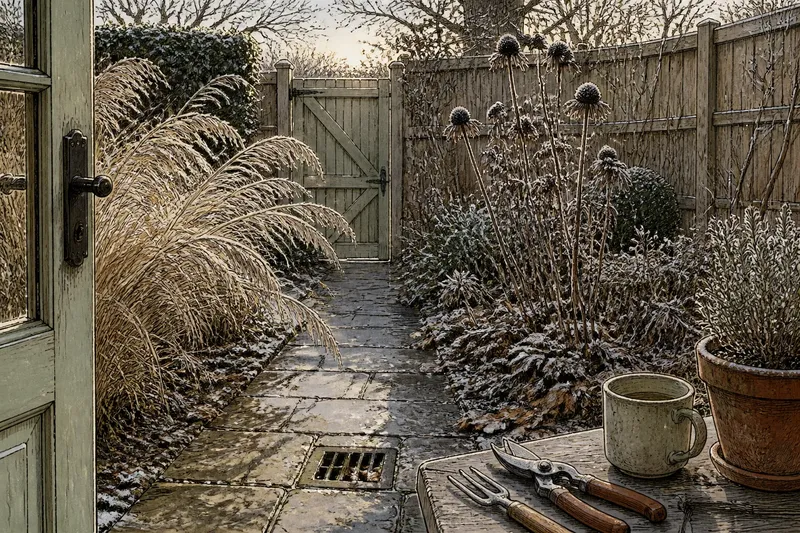
From the kitchen window, a row of frost-bright seed heads can turn a plain fence into a winter view. Bare garden winter interest is not only a matter of what remains after flowers fade; it is also a way to notice the garden’s boundaries, paths and changing light.
Rather than treating the dormant garden as a border that needs either clearing or preserving, look at it as a small landscape. Its winter character comes from the relationship between plants, built edges and the places from which you see them.
Read the garden’s outline
Start with the larger shapes: a hedge, a wall, a gate or the curve of a path. These features remain legible when foliage dies back, so they can help you judge whether a planting feels open, crowded or balanced.
Then notice how plants meet those edges. A tall stem may echo a fence post; a rounded clump of grass may soften the corner of a paving slab. The aim is not to make every plant visible, but to keep the garden’s overall outline easy to read.
Notice boundaries and paths
Winter growth can make a path feel narrower without actually changing its shape. Stems leaning over a step, a gate latch hidden by foliage, or leaves gathered against a drain are practical details that affect how the garden works as well as how it looks.
Use secateurs to remove only the material that obstructs access or obscures a useful feature. Keep a hand fork nearby for loosening compacted leaves from around plants, and avoid disturbing crowns or emerging shoots when you clear debris.
What does the winter view need?
How do I assess the garden from indoors?
Choose a window you pass often and look at the garden without first deciding what needs cutting. Notice which boundaries remain clear, where plants merge into a mass, and whether any stem draws the eye towards an awkward or blocked area.
What should I do with fallen leaves?
Leaves caught on a path, drain or plant crown may need removing, while a loose layer elsewhere can remain until it becomes troublesome. If you cannot tell whether leaves are hiding new growth, move them carefully by hand rather than raking through the bed.
When should I cut back a plant?
Cut back a stem when it blocks access, has collapsed into a wet tangle, or conceals a feature you need to see. If it remains upright and does not cause a practical problem, leave it for now and review it again as the weather changes.
Can winter structure work in a small garden?
Yes: a clear gate, an uncluttered step or one visible plant against a fence can give a compact space definition. Keep the view simple, and let the boundary and route through the garden do some of the visual work.
Work through one view
Imagine a small courtyard viewed from its back door: a miscanthus clump leans over the paving, a few echinacea heads stand against a timber fence, and damp leaves cover the drain. The gardener first moves the leaves by hand and finds the drain opening; next, they trim the grass that crosses the walking route, then step back to see whether the remaining stems still frame the fence.
The resulting view has a clear route and visible drain, while the echinacea heads remain as a distinct feature. If the remaining stems still obscure the gate, the gardener can remove those particular stems too; if the gate is clear, there is no need to cut the rest simply for uniformity. These details are invented, but the sequence shows how each action can follow an observable condition.
Make small decisions
Use the following checks as a way to decide what deserves attention. Each one pairs an observation with an action, so the garden can be adjusted without stripping away every winter form.
- Check the path edge: if stems cross the walking line, trim the obstructing stems; if they stay clear, leave them and assess another part of the view.
- Check the gate: if foliage hides the latch or narrows the opening, cut back the material at the access point; if the gate works freely, keep the planting intact.
- Check the drain: if leaves cover its opening, lift them by hand; if the opening is visible and clear, leave the surrounding leaf layer undisturbed.
- Check the plant crowns: if loose leaves conceal signs of new growth, move the leaves gently by hand; if the crowns are visible, avoid unnecessary disturbance.
- Check the background: if a stem disappears against a busy hedge, view it from another angle before deciding to cut; if it reads clearly against a wall or fence, retain it unless it blocks something.
- Check for collapse: if a plant has fallen into a damp mass over a path or neighbouring growth, remove the material causing the obstruction; if it is simply leaning within the bed, leave it and review it later.
Let the view change
Rain can darken stems, frost can sharpen their edges, and wind can alter a plant’s position. A view that seemed crowded one week may open up after leaves fall, so it is useful to pause before making a broad cut.
For bare garden winter interest, choose one familiar view and ask whether its boundaries, access and plant shapes are easy to read. Make only the adjustment that answers a visible need, then look again after the next spell of weather; a clear path and an intact winter silhouette can belong in the same garden.