Reading the Shape of a Garden from Its Paths
Reading a garden’s shape from its paths reveals where the eye travels, how spaces connect and which openings make the layout feel inviting.
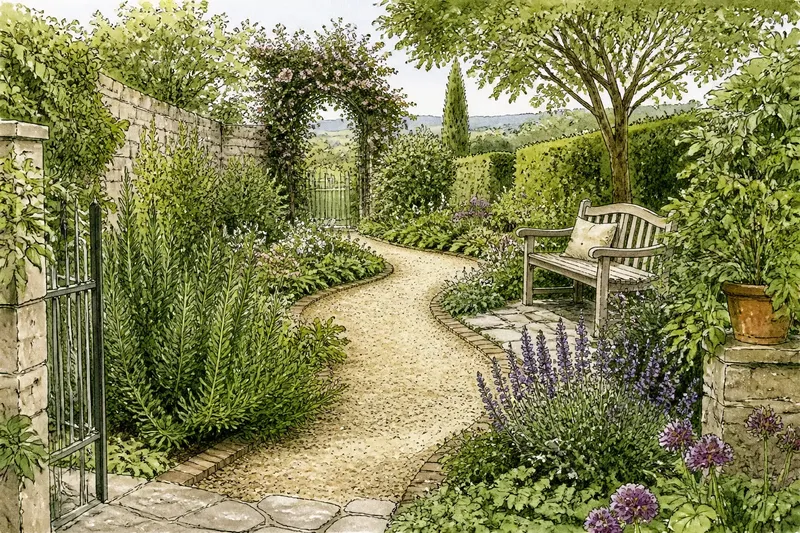
At the garden gate, a narrow gravel path slips behind a clump of rosemary, then reappears beside a bench. Reading a garden’s shape from its paths begins with this small change of direction: the route tells you what is visible, what is held back and where you are being invited to go.
A path is more than a convenient strip of ground. Its direction, edges and openings organise movement and help the eye make sense of the planting around it. Follow those clues and you can read the garden as a sequence of connected spaces rather than as a collection of separate beds.
Where does a path lead?
A path leads both the body and the gaze, but not always towards the same point. A straight route gives a clear view of its destination; a turning path offers a partial view and asks you to move before the next space comes into sight.
Stand at the entrance and look along the main route. Notice whether the far end is visible, blocked by foliage, or framed by a gap between trees. A visible destination can make a long view feel purposeful, while a screen of leaves can create the impression that the garden continues beyond what you can currently see.
The point that first draws the eye is often called a focal point: it might be a gate, a pot, a mature tree or a patch of bright paving. Ask whether the path actually reaches that feature, passes beside it or merely points towards it. Those differences matter. A route that ends at a feature feels direct; one that bends nearby may encourage a slower look around it.
A path can also lead away from the most obvious view. If the entrance faces a wall or dense planting, a side route may be the garden’s real invitation. Look for a change in paving, a widened threshold or a visible gap in the planting that signals where movement is expected to turn.
What do path edges reveal?
Path edges show how firmly the route is separated from the planted areas. A crisp line of brick or stone gives a clear boundary. Loose gravel meeting low groundcover makes a softer transition, while a mown strip through grass can leave the distinction deliberately slight.
Read both sides rather than assuming they match. A broad bed along one edge and a hedge tight to the other can make the path feel like a corridor. If the planting falls away on one side, the route may seem more open, even when the path itself has not changed width.
Materials contribute to the impression. Brick courses and sawn paving tend to draw the eye along their joints; irregular stepping stones invite attention to each foothold. These visual cues do not dictate how anyone must walk, but they can make a route feel either strongly directed or comparatively relaxed.
Look closely at where an edge changes. A kerb that stops beside a lawn, a border that widens near a seat, or a gravel line that dissolves into a courtyard may mark a transition between garden spaces. The path’s boundary is a little like the edge of a rug: it defines an area without necessarily closing it off.
How do openings change a view?
An opening is any place where the path or planting allows a view through: a gate, an arch, a break in a hedge or a gap between trunks. Its position affects what you notice next. A centred opening can make the route feel formal, while an offset one may pull the eye sideways and suggest another line of movement.
Consider what the opening reveals at standing height and from a lower angle. A low gap between plants might show a strip of lawn but hide the destination; an arch can frame a tree or a distant hill. The amount of the next space on view helps set expectations without explaining the whole layout at once.
Openings also connect spaces that are not physically joined by paving. A sightline from a terrace through a gate to a shed can make those places feel related. If the view ends at an unbroken fence, the route may feel contained; if it continues through another gap, the garden may appear to extend beyond its boundaries.
For a simple reading, trace the view from one opening to the next. Note where the line is interrupted and what replaces it: foliage, a building, a change in level or open sky. The interruption may be as deliberate a part of the composition as the view beyond it.
What does a bend do?
A bend changes the pace of looking. A gentle curve can reveal planting gradually, while a sharp turn hides what lies ahead until you reach it. Neither is automatically better; each gives the garden a different rhythm and degree of visual certainty.
Notice whether the curve has a reason you can see. It might pass around an established tree, avoid a damp hollow or connect two entrances. A route that bends without an obvious obstacle may still be shaping a longer view, bringing a particular border into focus or making a small space feel less quickly crossed.
Where a path widens, narrows or turns, ask what movement the change accommodates. A wider patch beside a bench suggests a place to pause without obstructing the route. A narrow section between walls may concentrate attention on the opening ahead. These changes often make the plan legible before any sign or label could.
For instance, say you inherit a garden with a straight paving run that ends at a blank fence. You could keep the route as a direct crossing, or, if a side gate already offers access to a sheltered corner, let a curved border and a modest change in paving draw attention towards that opening; the observable result would be a route whose destination is easier to recognise from the entrance.
How can I read a garden path without a plan?
Start at an entrance and follow the path at an unhurried pace, noting the first place your gaze settles and each point where the route turns or opens. Then look back from the far end: a garden can read quite differently in reverse, because a feature hidden on arrival may become the view you leave with.
Keep the exercise simple. You might jot down a few observations in a notebook, such as “gate visible from seat” or “path disappears behind apple tree”. This is not a survey; it is a way to distinguish the garden’s clear connections from the ones that remain concealed.
Does a straight path make a garden look formal?
It often gives a stronger impression of order because the eye can follow a continuous line towards a visible endpoint. The overall effect still depends on its setting: loose planting beside a straight route can soften that direction, while clipped edges can make it feel more deliberate.
Should a garden path always lead to a focal point?
No. A route may connect practical destinations such as a door, a compost area or a gate, and not every garden needs a feature at the end of its longest view. If the path appears to stop abruptly, however, check whether an opening or side route explains where movement is meant to continue.
What can a path tell me about a small garden?
It can show which areas are linked and where visual space is being borrowed from a neighbouring view. A route that bends behind a screen or points through a gate may make a compact plot feel connected to spaces beyond its immediate footprint, although the effect depends on what can actually be seen.
How do I tell whether a path feels welcoming?
Look for a visible entrance, a comfortable line of travel and some indication of what lies ahead. A clear opening or a slight widening can make the route easier to read, while an overgrown edge or an abrupt dead end may leave its purpose uncertain.
What should I notice before changing it?
Before altering a path, read its existing job as well as its appearance. It may carry people between a house and a gate, allow access for a wheelbarrow, keep feet away from wet ground or connect a seating place to a useful shed. A change that improves one view but makes an everyday route awkward may not serve the garden well.
Check the route from several ordinary positions: the doorway, the gate, a seat and the point where the path changes direction. Notice which destinations are visible from each place, and whether the borders or openings guide visitors towards the same destinations as the paving does.
If you are considering a small adjustment, begin with the visual clue you want to strengthen. Clearing foliage around an existing gap may reveal a connection; a low edging may clarify where gravel meets a bed; moving a pot may uncover a sightline. For alterations involving drainage, levels or access, local conditions and the relevant product guidance can affect what is suitable.
Reading the shape of a garden from its paths is ultimately a matter of tracing relationships: entrance to opening, edge to border, bend to destination. Once you notice those links, a route that seemed merely practical can show you how the garden holds attention, shares space and offers its next view.