Hedgerows as Living Boundaries in the Rural Landscape
Hedgerows as living boundaries shape rural views and shelter wildlife. Learn to read their layers, seasonal changes and openings before deciding how they work.
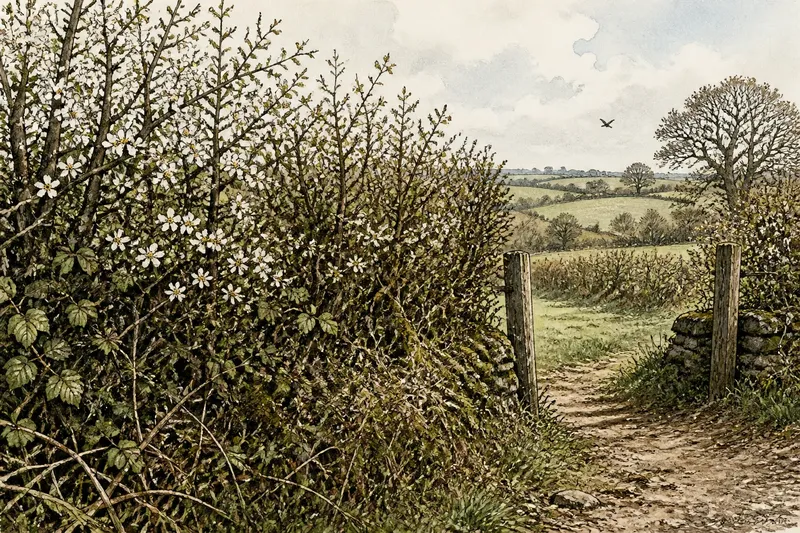
At a bend in a country lane, a blackthorn hedge hides the field beyond until the track rises; then the far hedge appears above it, stitched with hawthorn and bramble. Hedgerows as living boundaries do more than mark where one parcel ends and another begins: their depth, growth and gaps shape how the countryside is seen and used.
More than a line
On a map, a boundary can be drawn as a fine stroke. On the ground, a hedge occupies a strip of land, with a face towards the road, another towards the field and a changing interior of woody stems, leaves and dead material. Its edge may wander around a bank, ditch or old tree rather than follow a neat course.
That thickness matters. A hedge can screen livestock from a lane, soften the view of a farmyard and offer birds places to shelter. Its practical effect depends on what grows there and how the hedge has been managed, not simply on the line shown on a plan.
Think of it as a woven fence rather than a drawn mark: each stem contributes to a boundary that can thicken, thin or open over time. Like a loosely woven basket, it holds a shape while allowing small changes between its parts. The hedge is not a manufactured barrier, but a living structure with its own growth and seasonal changes.
Reading its layers
Look first at the base. A dense tangle of bramble, low branches and leaf litter can close the space beneath taller shrubs, while a bare, shaded bottom may leave a clearer view through. Neither appearance alone tells you the hedge’s history, but both show how its present structure differs from a narrow line.
Then look upwards and along its length. Hawthorn and blackthorn may form a thorny outer weave; hazel or field maple can add height and a broader canopy. A mature ash or oak within the hedge creates a landmark that rises above the regular rhythm of the shrubs.
Gaps are part of the reading, too. A gateway, a worn livestock opening or a place where plants have failed can interrupt continuity, yet each gap has a different cause and use. Notice whether the ground is banked, whether a ditch follows the hedge, and whether the plants stand on one side or both.
Seasonal edges
In spring, fresh leaves make the hedge appear fuller, while blossom can distinguish species that are difficult to pick out later. Hawthorn flowers brighten a stretch of lane; blackthorn blossom may arrive while branches are still mostly bare. The timing and display vary with place and weather.
Summer foliage often makes a hedge feel like a solid screen. By autumn, berries and seed heads bring colour and attract attention to its food-bearing plants; in winter, the woody framework returns to view. A boundary that seemed uniform in leaf may reveal gaps, bends and individual trees once the canopy thins.
These changes affect the landscape’s sense of enclosure. A hedge can make a field feel like a room in summer, then open a longer view in winter without moving an inch. For anyone observing a place, the season is part of the boundary’s visible form, not merely a backdrop.
What does a hedge tell you?
Why do some hedges follow a bank?
A bank can lift the hedge above the surrounding ground and may be paired with a ditch, making a broader boundary feature. Its shape can suggest that people have built up or cut into the land, though the appearance alone cannot establish when or why.
Why are trees left in a hedge?
Some trees have been retained as standards, growing above the shrubs and giving the boundary a taller, more open rhythm. They may also provide shade and habitat, while marking a route or division in the landscape.
What can a gap mean?
A gap may be an intentional entrance, a passage for stock or a break caused by neglect, shade or damage. Look for a gate, a worn track and the condition of nearby growth before deciding how it functions.
Does a thick hedge always mark an older boundary?
Thickness is not a reliable age guide on its own: vigorous growth and recent planting can produce a substantial screen, while cutting may keep an old hedge narrow. Banks, ditches, mature trees and the route’s relationship to fields offer additional clues, but no single feature settles the question.
Care and continuity
Management alters both the boundary’s appearance and its practical role. Repeated cutting can keep a hedge compact; allowing some growth to flower and set fruit can give it a more varied profile. Laying, coppicing and gap planting are traditional ways of maintaining hedges, but the suitable approach depends on the hedge’s condition, purpose and local practice.
Before work is planned, identify who is responsible for the boundary and check relevant local rules and any grant or land-management conditions. For a particular hedge, a qualified hedgerow contractor or local conservation adviser can help assess what is appropriate; instructions and rules differ by place.
Say you are assessing a thin stretch between a pasture and a lane. It has a sound bank, several hawthorn stems, a ditch that remains clear, and an opening where a gate once stood; the worn track through it suggests that people still use the route.
Imagine recording those details on a sketch, then checking the opening from both sides and asking the land manager whether access is still needed. If the route remains in use, the decision would be to retain the opening and avoid planting across it; if access has ended and the land manager confirms that, gap planting beside the existing hawthorn could strengthen cover while keeping the bank and ditch intact. The observable result would be either a usable passage or a more continuous hedge, rather than an unexplained break.
When reading hedgerows as living boundaries, follow the whole strip rather than tracing its centre. The change from hedge to bank, from bank to ditch, or from dense growth to a gateway often explains how a rural boundary works more clearly than its position on a map.