Perennial or Annual: Two Different Jobs in a Border
Perennial or annual planting can give a border both lasting shape and seasonal colour. Learn how to choose roles, place plants and manage the change.
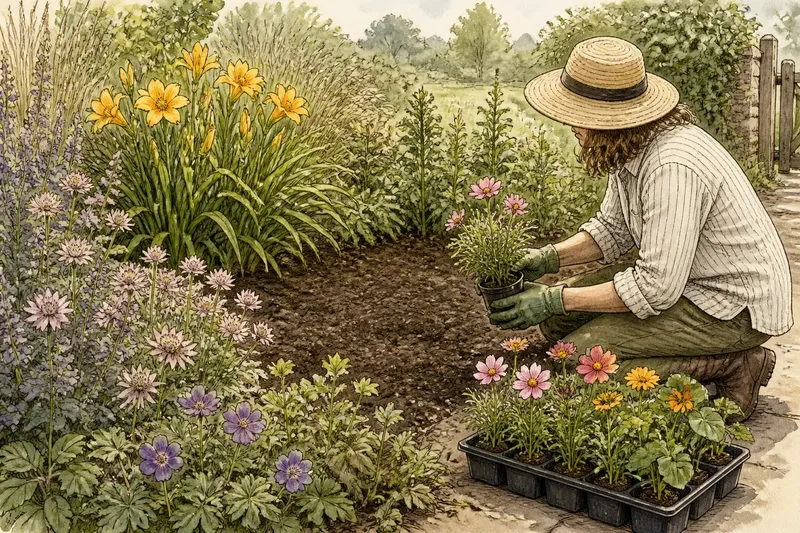
A tray of young plants waits beside a bare patch in the garden border, while the daylilies nearby are still making leaves. Choosing perennial or annual plants for that space is less a contest between lasting and temporary than a decision about what should return and what may change with the season.
Perennials live for more than one growing season, often returning from persistent roots, bulbs or other plant parts. Annuals complete their life cycle within one growing season, although some may self-seed; in milder climates, plants commonly treated as annuals may persist longer, and a plant classed as perennial in one region may not survive winter elsewhere.
Read The Border
Look at the border across the seasons rather than judging it at peak flowering. Notice where spring bulbs leave open ground, which foliage remains after flowers fade, and where plants cut back for summer create a gap.
Perennials often give the planting a recurring framework. A hardy geranium may return in its established position, while calendula in a nearby opening can bring a temporary change in flower form. Like a well-used table with a steady surface and a changing arrangement of dishes, the border can retain its shape without looking exactly the same each season.
Choose The Lasting Plants
Begin with the parts of the border you want to recognise each year. Consider sunlight, whether the soil tends to dry or stay damp, and how much room each plant will need as it matures. A small pot can grow into a substantial clump.
Give each perennial a job as well as a place. Low, spreading plants can soften the front edge; upright forms can carry the eye through the middle; and foliage plants can remain interesting after flowering. Catmint, astrantia and ornamental grasses offer different shapes, but their suitability depends on local conditions and available space.
Check the plant label or supplier’s guidance for mature spread, then leave room accordingly. If that information is unclear, ask the supplier before setting out plants; crowding young perennials may create a full first impression but leave them competing as they grow.
Give Annuals A Purpose
Use annuals where a temporary plant can make a clear difference: a pause between perennial flowers, a patch near a path, or a loose scatter among more orderly foliage. Their value lies in the option to change a section without moving established plants.
Choose by form and growing conditions. Cosmos has an open shape that can sit among sturdier foliage; nasturtiums may spill over an edge; calendula can add a warm note. Decide whether to sow directly, raise plants in pots or buy young plants. Direct sowing suits an open patch where an informal finish is welcome, while plug plants make it easier to place colour in defined gaps.
Prepare an open pocket of soil if existing foliage would overwhelm seedlings. Follow the seed packet for sowing depth and other specific needs, since not all annual seeds are sown in the same way.
Plan Seasonal Change
Arrange plants so one group does not have to carry the border all season. Early-flowering perennials may leave attractive leaves behind as later flowers come on. Annuals can bridge a quiet spell, but need not conceal every fading perennial; seed heads and changing foliage can remain part of the display.
Consider views from the house, a gate or a path. Put taller plants where they will not obscure a valued view, and use lower plants along the front edge. Repeating an annual in separate pockets can connect parts of a border without turning them into a solid block of one colour.
Say you have a border where spring bulbs leave an open patch by early summer, and a group of daylilies is still building foliage. In this invented situation, you reserve the patch for cosmos, choose a variety suited to the light and available height, and set it in front of the daylilies. The expected result is a temporary veil of flowers while the perennial clump remains in place; if the cosmos shades nearby plants, you remove or relocate some of it, accepting a less full display in exchange for more room.
Set Out Plants
Arrange pots or plant labels on the soil before planting, then view the layout from several positions. Move the annuals until their colour and height suit the gaps, but avoid disturbing established perennial roots just to make the pattern more regular.
Loosen the ground where each plant will go and remove competing weeds. If pot compost is dry, water the pots before planting. Set each plant at the depth specified on its label, firm the soil gently around the roots, then water the area so the surrounding ground is moist.
For seed, prepare a fine, open surface and follow the packet’s sowing instructions. Keep the seedbed from drying as seedlings develop, and thin crowded seedlings if the packet advises it.
Check The Balance
Use these observations to decide whether the planting needs an adjustment:
- If an annual spreads across a perennial’s young growth, remove or relocate part of the annual planting; if it stays clear, leave the arrangement in place.
- If a perennial occupies more ground than expected, reduce nearby annuals or move them to another open patch; if the intended space remains clear, keep the original positions.
- If seedlings emerge where they would crowd valued plants, remove those extras; if they appear in a useful gap, let them grow there.
- If a planting spot dries quickly while its chosen plant wilts, check the plant’s growing needs and move or replace it with a better-suited option; if the plant remains settled, keep the pairing.
- If taller growth blocks a valued view from a path or window, relocate or cut back the obstructing plant as appropriate; if the view stays open, retain the arrangement.
- If a gap appears after flowering and looks bare to you, consider an annual suited to that spot; if foliage or seed heads already give it interest, leave the space unfilled.
Maintenance differs by plant. Perennials may need deadheading, division or support; annuals may need watering, deadheading or removal as their display ends. Keep a brief note of positions that became crowded or stayed useful, so next season’s changes reflect what the border did.
Which Role Fits?
Do perennials flower every year?
Many flower in successive seasons once established, but flowering depends on the plant and its growing conditions. Some put more energy into roots and foliage before giving a fuller display.
Can annuals return by themselves?
Some annuals self-seed when flowers are left to form seed and conditions suit germination. Keep seedlings that contribute to the planting and remove those that crowd valued plants.
Should a border be mostly perennial?
There is no single balance for every border. If you want a settled arrangement, use more perennials; if you enjoy changing the colour and layout, leave more room for annuals and their seasonal upkeep.
Can annuals grow beside perennials?
Yes, if both have enough light, water and room. Set annuals in open spaces where they will not smother perennial crowns, and choose plants with compatible growing needs.
Let The Border Evolve
The roles need not remain fixed. A perennial may spread into ground once set aside for annuals, or an annual may prove useful in a recurring gap. Keep the plants that give the border its continuity and change those that make room for a welcome seasonal shift.
For a perennial or annual border, decide which effect you want to persist and which may pass. Leave some annual flowers to set seed if you welcome their return, but remove them where they would crowd valued plants. That choice lets the planting change while preserving the shape you want to keep.